Struggling rural churches in England are to be given a giant funding boost after a £180,000 training project was given the green light this week.
Funded by the Arthur Rank Centre (ARC), a Church of England-backed organisation which supports rural communities and churches, the money is in response to an urgent call from church leaders.
The initiative, called ‘Rural Life and Faith’, could benefit 13,000 rural churches of all denominations and will help equip them for a modern role in villages and the countryside.
Dr Jill Hopkinson, National Rural Officer for the Church of England, who will be heading the project, said: “The church is a vital force in vibrant village communities. But ARC has identified big problems in training provision through research, our teaching and training activities, the experience of the National Rural Officers and their networks, and calls from church leaders.”
She added: “The message is that rural training and development (particularly for lay people) is insufficient and inadequate.
“Rural Life and Faith responds to that need, and will build new skills, confidence and competence specific to rural situations. The idea is that rural churches will respond more readily to opportunities, and maintain a flourishing Christian presence in their communities.” Read more
No comments will be posted without a full name and location, see the policy.
Wednesday, 6 May 2009
Financial boost for rural churches

The Church of England must open up or shut up
At 10.30 this morning, the planning committee of Exmoor National Park will sit at its headquarters in an old Victorian workhouse, behind the statue of local heroine Lorna Doone in Dulverton, to decide whether All Saints Church at the top of the hill should be allowed to have a new road put across its ancient graveyard for "vehicular access".
This is a hot issue for the locals of this medieval wool town, just the Somerset side of the Devon border. For metropolitan visitors and tourists, it is the sort of ecclesiastical drama that surely ranks somewhere between Trollope and The Archers.
But it is more than that. The "Grasscrete" and tarmac road into All Saints is a prime example of how the church is torn between modernity and tradition. Unless the church offers access, in every sense, to the community it serves, then it will die as a museum piece. That's one view. Then there's: don't mess with the tranquillity of this beautiful example of our holy architectural heritage.
Government and the Church of England seem inclined to the former view. Last month, culture secretary Andy Burnham proposed the introduction of health surgeries, post offices and day-care centres in churches, an initiative that was welcomed by, among others, Dr Richard Chartres, Bishop of London. Read more
No comments will be posted without a full name and location, see the policy.
Hospital bans pictures of churches as public sector continues crusade against Christianity
I know I've written about it before, but anyone who is still in doubt that the public sector has got it in for Christianity should note that Havering Council has just asked local artists for paintings to brighten up the walls of Queen's Hospital, Romford.
The only condition? That the artworks do not depict churches. Not any places of worship, just churches.
However, as I wrote in my latest column for the Church of England Newspaper, some people are still trying to knock down these stories about Christians suffering at the hands of public officials. How many more examples do they want? Here's the column: Read more
No comments will be posted without a full name and location, see the policy.
Tuesday, 5 May 2009
Orombi appeals to Canterbury over refused Uganda delegate to ACC: Correspondence
From Henry Orombi to Kenneth Kearon
23 April 2009
Revd Canon Kenneth Kearon
Anglican Consultative Council
St Andrew’s House
LONDON
Dear Canon Kearon,
Easter Greetings from Uganda in Jesus’ name! This letter is to inform you that we have appointed Rev. Philip Ashey as our clergy delegate to the ACC meeting in Jamaica. Here is his contact information
Rev. Philip Ashey
Church of Uganda
P.O. Box 14123
Kampala
UGANDA
philashey@
As you know, Bishop Paul Luzinda is not able to attend the meeting, so we have forwarded to Rev. Philip the preparation material you sent him.
We are covering the travel expenses for Rev. Philip, so there is no additional cost to the ACC.
Yours, in Christ,
The Most Rev. Henry Luke Orombi
Archbishop of Church of Uganda
xc Rev. Philip Ashey
Jolly Babirukamu
Provincial Secretary
_______________________________
From Kenneth Kearon to Henry Orombi
From: Kenneth Kearon [mailto:kenneth.kearon@] Sent: Friday, April 24, 2009 4:44 PM To: Archbishop COU Subject: RE: New ACC Delegate for Jamaica from Uganda
Dear Archbishop,
I'm grateful for the nomination of Rev. Philip Ashley as ACC delegate. I note he will make his own arrangements to get there, and I look forward to welcoming him to ACC.
In Christ,
Kenneth.
Kenneth Kearon,
Secretary General of the Anglican Communion,
St Andrew's House,
16 Tavistock Crescent,
London, W11 1AP
Tel: +44 (020) 7313 3903
________________________
From Henry Orombi to Kenneth Kearon
From: Archbishop COU [mailto:abpcou@] Sent: 24 April 2009 13:00 To: Kenneth Kearon Cc: Yoshimi Gregory; 'Aaron Mwesigye' Subject: New ACC Delegate for Jamaica from Uganda
Dear Canon Kearon,
Greetings in the name of our Lord Jesus Christ!
Please receive the attached letter from me informing you of a clergy delegate we have appointed to attend the ACC meeting in Jamaica.
Yours, in Christ,
The Most Rev. Henry Luke Orombi
ARCHBISHOP OF CHURCH OF UGANDA
P.O. Box 14123
Kampala
UGANDA
Ph: +256 414 270 218
Fax: +256 414 251 925
abpcou@
_________________________
From Kenneth Kearon to Henry Orombi
The Most Revd Henry Orombi
Archbishop of the Church of the Province of Uganda
29th April 2009
Dear Archbishop Orombi,
I acknowledge your letter of 23 April 2009 nominating Revd Philip Ashey as a clerical representative to the ACC for the Church of the Province of Uganda, and I have referred it to the Joint Standing Committee.
That Committee has noted
(i) that Mr Ashey has already been given Press Accreditation status to the ACC on behalf of the American Anglican Council;
(ii) he has given his address as Henderson Mill Road, Atlanta, Georgia, USA.
The JS Committee is concerned that a person with Press Accreditation has been nominated as a representative, because the press is excluded from some of the business of the Council. It is further concerned that a person not resident in the Province of Uganda should be asked to represent your Province.
The JSC seeks urgent clarification on these issues in order to consider the matter further.
Yours sincerely.
Sincerely.
Kenneth Kearon
Secretary General of the Anglican Communion
_______________________
From Henry Orombi to Kenneth Kearon
30th April 2009
Rev. Canon Kenneth Kearon
St. Andrew’s House
16 Tavistock Crescent
London, England W11 1AP
Dear Canon Kearon,
Thank you so much for your letter of 29th April 2009 seeking clarification about our appointment of Rev. Philip Ashey as our clergy delegate to the ACC from the Church of Uganda.
We have asked Rev. Ashey to relinquish his press credentials in order to eliminate any conflict of interest that may have been implied, and it is my understanding that he did relinquish those press credentials prior to your letter to me.
The appointment of delegates from each Province is, according to the Constitution of the ACC, a purely internal matter of each Province and not subject to review by any body within the ACC, including the Joint Standing Committee. Rev. Philip Ashey is a priest in good standing of Ruwenzori Diocese and has been appointed by me as the clergy delegate from the Church of Uganda. I trust that, with his relinquishment of his press credentials, you will accord to him every courtesy expected of any appointed delegate from any Province of the Anglican Communion. And, I further trust that this resolves the concern you may have.
Thank you for your good work, and we look forward to hearing about the fruitful deliberations of the ACC-14.
Yours, in Christ,
The Most Rev. Henry Luke Orombi
ARCHBISHOP OF CHURCH OF UGANDA.
xc: The Most Rev. Rowan Williams, Archbishop of Canterbury
Rev. Philip Ashey, Church of Uganda Clergy Delegate to the ACC
Mrs. Jolly Babirukamu, Church of Uganda Lay Delegate to the ACC
Rev. Canon Aaron Mwesigye, Provincial Secretary
_____________
From Kenneth Kearon to Henry Orombi30 April 2009
The Most Revd Henry Luke Orombi
Archbishop of Church of Uganda
PO Box 14123
Kampala
Uganda
Dear Archbishop Henry,
Thank you for your prompt response to my letter of 29 April.
The Joint Standing Committee has discussed this at length. We understand that the Revd Philip Ashey’s relationship with the Church of the Province of Uganda is as a result of a cross provincial intervention, and note that such interventions are contrary to the Windsor Report and other reports accepted by successive meetings of the Instruments of Communion, including Primates’ Meetings which you have attended.
Therefore we regret to inform you that Mr Ashey’s current status means that we cannot regard him as a ‘qualified’ member according to Section 4(e) of the current Constitution. We are content for him to resume his Press Accreditation, if he so wishes.
Yours sincerely,
The Revd Canon Kenneth Kearon
Secretary of the Anglican Communion
Cc: The President of ACC
The Chair of ACC
The Revd Philip Ashey – via email
_____________________
From Henry Orombi to Rowan Williams
2nd May 2009
The Most Reverend Rowan Williams Archbishop of Canterbury and
Chair of the Primates Standing Committee
Lambeth Palace
London, England
Via e-mail
Your Grace,
I have received a letter from Reverend Canon Kenneth Kearon, dated 30th April, refusing to seat the Church of Uganda’s clergy delegate to the ACC, Rev. Philip Ashey. I assume you have seen a copy of his letter, and that you may have been part of the discussion of this matter in the meetings of the Joint Standing Committee.
Canon Kearon’s letter states that the Joint Standing Committee has determined that Rev. Philip Ashey is not ‘qualified’ under Section 4(e) of the ACC’s Constitution because we received him into the Church of Uganda in 2005 as part of our pastoral care to Anglican clergy and congregations in America who were being persecuted for upholding Lambeth 1.10 in the context of a Province that willfully violated and continues to violate it.
As I wrote in my first letter to Canon Kearon, appointment of delegates to the ACC from a Province is purely an internal matter and is not subject to review by any body within the ACC, including the Joint Standing Committee. That the Joint Standing Committee would assume such authority is a gross violation of our constitutional relationships, not to mention a further tearing of our bonds of affection. Our reasons for appointing one of our American priests to represent us as our clergy delegate are our reasons, and are not for the Joint Standing Committee to question.
The appointment of Rev. Philip Ashey to fill a vacancy at the last minute provides the Church of Uganda with a strong voice of a priest in good standing in the Diocese of Ruwenzori. It is also a voice for the almost 100,000 orthodox Anglicans in North America who have been persecuted by TEC and the Anglican Church of Canada, who will not be represented by their delegations to ACC-14, and who will not otherwise have voice or seat at the table of the ACC. It is important for the Communion to be reminded that there is a serious tear in the fabric of our communion; all is not well and there continues to be an urgent need to address the ongoing crisis before us.
Section 4(e) does not give the Joint Standing Committee or the ACC the right to interfere in the appointing body’s determination of the “qualification” of a delegate. For the Joint Standing Committee to assume this power is nothing short of an imperialistic and colonial decision that violates the integrity of the Church of Uganda.
I reiterate – Rev. Philip Ashey is a priest in good standing of Ruwenzori Diocese and has been appointed by me as clergy delegate from the Church of Uganda. This is sufficient and the Joint Standing Committee does not have a right to challenge it.
It is, furthermore, very dangerous for Canon Kearon’s letter to quote the Windsor Report and Communiqués of the Primates as the basis for refusing to seat Rev. Philip Ashey as our clergy delegate. None of these documents has authority to override the Constitution of the ACC. Furthermore, none of these documents ever suggested a moral equivalence between the pastoral care offered to persecuted clergy and congregations in North America and the violation of Biblical and historic Anglican teaching by TEC and the Anglican Church of Canada on the blessing of same-sex unions and the ordination as bishop of persons living in same-sex relationships.
At our Primates meeting in Dromantine, Northern Ireland, we asked TEC and the Anglican Church of Canada to voluntarily withdraw from the Councils of the Church until the next Lambeth Conference. In Dar es Salaam, the Primates unanimously agreed that TEC should not be invited to Lambeth until they satisfactorily answered our questions, which most people know they did not do, your judgment notwithstanding. Yet, they have continued to be involved in all the Councils of the Church, and even with undue influence because of their wealth and command of English as their first language. There is a double standard at work here, and it favors the Western world and marginalizes Africa and others in the Global South.
We, therefore, appeal to you, in your capacity as Chair of the Primates Standing Committee and President of the ACC, to help the Joint Standing Committee understand the limits of their authority and to recognize the appointment of the Rev. Philip Ashey as clergy delegate to ACC-14 from the Church of Uganda, and to accord to him every courtesy expected of any delegate from any Province of the Anglican Communion. This is a matter of urgency, and I look forward to hearing from you at your earliest opportunity.
If the Church of Uganda’s appointment of Rev. Philip Ashey is considered by you to be unacceptable, then we will be forced to take the steps necessary to bring this unbiblical, unjust and unconstitutional precedent to the attention of the rest of the Communion.
Yours in Christ,
The Most Rev. Henry Luke Orombi
ARCHBISHOP OF THE CHURCH OF UGANDA.
xc: Rev. Canon Kenneth Kearon, Secretary General, ACC
Rev. Philip Ashey, Clergy Delegate to ACC-14
Mrs. Jolly Babirukamu, Lay Delegate to ACC-14
Rev. Canon Aaron Mwesigye, Provincial Secretary
No comments will be posted without a full name and location, see the policy.
ACC Refuses to Seat Ugandan Delegate
CHURCH OF UGANDA
P.O. Box 14123, Kampala
FOR IMMEDIATE RELEASE
4th May 2009
In an e-mail dated 24th April, Rev. Canon Kenneth Kearon, Secretary General of the Anglican Consultative Council, wrote the Most Rev. Henry Luke Orombi, Archbishop of the Church of Uganda, saying, “I’m grateful for the nomination of Rev. Philip Ashey as ACC Delegate…and I look forward to welcoming him to ACC.”
Rev. Philip Ashey is a priest of Ruwenzori Diocese in the Church of Uganda, living and working in Atlanta, USA.
During the first press briefing, Venerable Paul Feheley, the ACC’s Spokesperson, stated that each province appoints its own delegates to the ACC, as written in the constitution of the ACC.
In a surprising move, the Joint Standing Committee, meeting on 1st May, exceeded the limits of their authority, reversed Canon Kearon’s decision of 24th April, and determined that Rev. Ashey was not “qualified” to serve as a delegate, citing section 4(e) of the Constitution of the ACC. Their reason? Rev. Ashey is an American who was received into the Church of Uganda in 2005.
In a 2nd May letter appealing to the Archbishop of Canterbury, Archbishop Orombi wrote,
“The appointment of delegates to the ACC from a Province is purely an internal matter and is not subject to review by any body within the ACC, including the Joint Standing Committee. That the Joint Standing Committee would assume such authority is a gross violation of our constitutional relationships, not to mention a further tearing of our bonds of affection. Our reasons for appointing one of our American priests to represent us as our clergy delegate are our reasons, and are not for the Joint Standing Committee to question. Section 4(e) does not give the Joint Standing Committee or the ACC the right to interfere in the appointing body’s determination of the “qualification” of a delegate. For the Joint Standing Committee to assume this power is nothing short of an imperialistic and colonial decision that violates the integrity of the Church of Uganda.”
When asked why he didn’t send a Ugandan priest to represent the Church of Uganda, Archbishop Orombi replied, “We had a last minute vacancy for our clergy delegate and couldn’t organize travel and visas for one of our Ugandan clergy to go. When we learned that our priest, Rev. Philip Ashey could go to Jamaica, we asked him to represent us.”
Orombi continued, “The appointment of Rev. Philip Ashey to fill a vacancy at the last minute provides the Church of Uganda with a strong voice of a priest in good standing in the Diocese of Ruwenzori. It is also a voice for the almost 100,000 orthodox Anglicans in North America who have been persecuted by TEC and the Anglican Church of Canada, who will not be represented by their delegations to ACC-14, and who will not otherwise have voice or seat at the table of the ACC. It is important for the Communion to be reminded that there is a serious tear in the fabric of our communion; all is not well and there continues to be an urgent need to address the ongoing crisis before us.”
When asked why he was not present for the meeting, Archbishop Orombi said, “I am speaking at the New Wine conference in the north of England at the same time the ACC is meeting. This speaking engagement has been in my diary for a long time. It was an unavoidable conflict. I regret that my alternate to the Primates Standing Committee, Archbishop Justice Akrofi of West Africa, was also not able to attend.”
The Church of Uganda’s Bishop delegate was not able to attend the meeting because of a conflict with a previously scheduled trip to the UK.
The Church of Uganda will be represented only by its lay delegate, who protested the decision of the Joint Standing Committee to refuse to seat Uganda’s clergy delegate. Her protest was, nonetheless, overridden by other interests on the Joint Standing Committee.
+ END +
Correspondence related to this unfortunate incident is attached.
For interviews, please contact
Mr. Onesimus Asiimwe, Chaplain to the Archbishop of Uganda, at +256 717 111 222 (Uganda)
Rev. Philip Ashey at +1 876 282 3572 (Jamaica)
Church of Uganda
P.O. Box 14123
KAMPALA
+256 782 321 027
No comments will be posted without a full name and location, see the policy.
The Covenant: an introduction by Archbishop Drexel Gomez
[...] If we are not able to commit ourselves to this sort of being a Communion, the break up of its life is staring us in the face. Either we are a family, which means that each member of the family has care for and respect for the other members of the family, or we will have to learn to go our separate ways. The question is: do we wish to remain a Communion?
I’m afraid to say that I think that is fundamentally the choice before ACC in these two weeks. What is decided here is likely to make or break the Communion. Read more
No comments will be posted without a full name and location, see the policy.
Saturday, 2 May 2009
The Truth Delusion of Richard Dawkins
The most famous atheist in the world, biologist Professor Richard Dawkins, poses as the arch-apostle of reason, a scientist who stands for empirical truth in opposition to obscurantism and lies. What follows suggests that in fact he is sloppy and cavalier with both facts and reasoning to a disturbing degree.
I previously wrote about the remarkable debate (which can be seen at this website) between Dawkins and John Lennox, Professor of Mathematics and Fellow in the Philosophy of Science at Oxford. Lennox is the author of God’s Undertaker: Has Science Buried God? which demolishes Dawkins by showing not only that there is no inherent conflict between science and faith but that the argument for faith is now being bolstered enormously by the remarkable developments in science. Dawkins was on the back foot because Lennox was attacking him from his own platform of science. He was on safer ground only when, in a further debate between the two at Oxford’s Natural History Museum last October, he attacked Lennox for his Christian faith which he could more easily ridicule. But to Lennox’s core arguments, he seemed to me to have no convincing response.
In a lecture earlier this month to the American Atheists’ Convention in Atlanta, Georgia, Dawkins chose to attack Lennox (about 15 minutes into this video) from the safety of an unchallenged speaking spot in front of a sycophantic audience – but in a manner which inadvertently revealed rather more about himself than he bargained for. Describing Lennox belittlingly as a ‘Christian apologist’ and an ‘Irish mathematician’, he took a comment Lennox had made at a meeting two days after the Oxford debate and tried to debunk it by claiming that Lennox had misrepresented him.
Lennox had observed that, in the Oxford debate, Dawkins appeared to have made a stunning admission by saying that ‘a good case could be made for a deistic god’(a generalised kind of deity as opposed to the personalised God of the Bible). Lennox observed that acknowledgement of a deistic god was the position arrived at recently by the celebrated former atheist philosopher Anthony Flew; and that saying a good case could be made for such a god ‘knocked the heart out’ of Dawkins’s core contention that complex life forms had derived from simple ones.
In response, Dawkins tried to maintain that Lennox had grossly misrepresented him. Pointing out that he had gone on to say that he didn’t accept the deistic argument – which indeed he had said – he claimed that Lennox had selectively quoted him to give an entirely false impression. To make his point, he drew an analogy with the conceit, once employed by a particular astronomer, of ironically disdaining authoritative sources purely as a rhetorical device to underscore the truth of an argument. Just as it would be dishonest to treat such ironic disdain as if it was seriously meant, he said, so by analogy Lennox was being dishonest by treating Dawkins’s remark about deism as if it was seriously meant when in fact he had merely been
making the concession about deism to show up the fatuousness of his [Lennox’s] belief.
But it was Dawkins’ argument which was surely disingenuous. Read more
No comments will be posted without a full name and location, see the policy.
Atheists target UK schools
The National Federation of Atheist, Humanist and Secular Student Societies (AHS) plans to launch a recruitment drive this summer.
Backed by professors Richard Dawkins and AC Grayling, the initiative aims to establish a network of atheist societies in schools to counter the role of Christianity.
It will coincide with the first atheist summer camp for children that will teach that religious belief and doctrines can prevent ethical and moral behaviour.
The federation aims to encourage students to lobby their schools and local authorities over what is taught in RE lessons and to call for daily acts of collective worship to be scrapped. It wants the societies to hold talks and educational events to persuade students not to believe in God.
Chloë Clifford-Frith, AHS co-founder, said that the societies would act as a direct challenge to the Christian message being taught in schools.
She expressed concern that Christian Unions could influence vulnerable teenagers looking for a club to belong to with fundamentalist doctrine.
In particular, she claimed that some students were being told that homosexuality is a sin and to believe the Biblical account of creation.
"We want to point out how silly some of these beliefs are and hope that these groups will help to do that," she said. Read more
No comments will be posted without a full name and location, see the policy.
Friday, 1 May 2009
We are all suspects in the new inquisition's eyes
In these straitened times, it's good to know that jobs are still being created. A quango called the Independent Safeguarding Authority, which will open this October, already has a well-staffed helpline and is advertising for ICT (information and communication technologies) and finance specialists.
Never heard of it? You soon will. If you are one of the 11.3 million people who might, in the course of your work, come into contact with children or “vulnerable adults”, you will be paying for the privilege of being vetted by this new authority. Its net will catch almost everyone in the NHS, even cooks. It will encompass accountants and board members of charities. It will include anyone generous enough to offer work experience to a teenager, or a bed to a foreign-exchange student. It will vet a quarter of the adult population.
Just think: any one of those 11.3 million people could be a paedophile. And think again: this gargantuan system would not have prevented Ian Huntley from murdering two schoolgirls in Soham in 2002, even though that awful murder was what prompted the invention of the Independent Safeguarding Authority. Read more
No comments will be posted without a full name and location, see the policy.
Tuesday, 28 April 2009
BNP Updates Language & Concepts Discipline Manual
Ed: In the light of recent media criticism, the British National Party has revised its 'Language and Concepts Discipline Manual'. This is important reading for those who wish to understand and challenge the party. You can download it as a pdf here, but for convenience I duplicate it below, and would draw particular attention to Rule #13 and its first paragraph.
BNP Language & Concepts Discipline Manual
BNP Policy Research, UPDATED APRIL 2009
This document replaces all previous versions.
Politics requires propaganda, and effective propaganda requires self-discipline. It is essential that all official (and preferably unofficial, i.e. public comments by party members) BNP communications stick to the party’s true message and convey it to the voting public in a clear and consistent way.
The enemy wants us to be misunderstood — this is why they deliberately lie to the public about what we stand for — so we must do everything possible to make it impossible for the public to misunderstand us.
Therefore, BNP Policy Research has compiled the following rules of language and concepts discipline:
Rule #1: The BNP is not a ‘racist’ or ‘racial’ party. It should never be referred to as such by BNP activists, and anyone else who does so must be politely but firmly corrected. The precisely correct description of what we are, in the standard terminology of international comparative politics, is a ‘patriotic’ or ‘ethno-nationalist’ party. That is, we espouse, like many political parties all over the world, the interests of the particular ethnic groups to which we belong. If you are accused of being a ‘racist’ then do not try and get into a definition of what is meant by that. The answer is simply “no, the BNP is not racist” and that is all. Do not fall into the media trap of trying to debate what racism is — as soon as you hedge the question, you are giving them an opportunity to exploit. See the 2008 booklet Folk and Nation: Underpinning the Ethnostate for more details.
Rule #2: Do not hesitate to repudiate bad aspects of the BNP’s past. Point out that all parties have some people who have said and done silly things. The important issue upon which to focus is what is being said and done now. People can and do change, and this has happened to the BNP as well. There is no comparison between the BNP of ten or fifteen years ago, in the same way that there is no comparison between the Labour or Conservative Parties of now and twenty years ago. All parties evolve, mature, and change, and we do not have to be on the defensive for things said and done twenty years ago which have no relevance to the modern BNP.
Rule #3: The BNP’s core principle is one of Britain and British people first, and we do not hesitate to announce this from all public platforms. This is not an extreme position — in fact it is one which any normal country would have. If you are questioned on this, and there might be some people mad enough to call it into question, point out that the Japanese government always acts in the interests of the people of Japan etc., and that almost all nations in the world act in the interests of their own people first. This does not mean that the Japanese “hate” anybody else, merely that they have the good sense to put their own interests first. In this way, the BNP makes no secret of the fact that it seeks to put British people and British interests first, and this includes putting measures in place to ensure that the majority population of this nation remains ethnically British. This is not a policy to hide — on the contrary, it is one to
discuss openly, as it differentiates the BNP from all the other political parties who seek the exact opposite.
Rule #4: The BNP campaigns in a totally lawful manner. Our experience has shown time and time again that agent provocateurs who suggest nonparliamentary means of political activity are most often extreme left infiltrators who seek to create situations wherein the media can portray the BNP in a bad light. Any member hearing any such language or suggestions must immediately report it to their party senior who must then pass the information upwards, never outwards, so that it can be dealt with as quickly as possible.
Rule #5: Always remember that the BNP’s policies are basic common sense, and mainstream. Repeated opinion polls show that on our core issues, the majority of the public agree with us and the extremists are the establishment politicians. Do not let interviewers or opponents get away with using the words ‘extreme’ or ‘far right’ or such terms. Challenge such statements immediately by asking what is so ‘extreme’ about any of them. The interviewer
or opponent will quickly be put on the spot to justify his position, and will be hard-pressed to show that a policy (such as) “Britain for the British” is extreme. (You can point out that everyone agrees Tibet should be for the Tibetans, and that is not regarded as ‘extreme’.)
Rule #6: The BNP is not ‘anti-European’. We are ‘anti-EU’ or ‘anti-European Union’ or ‘anti-Brussels’. Do not criticise Europe per se — only the institution of the EU, which is a liberal/fascist monstrosity designed to destroy national borders, identities and cultures, and which poses the greatest threat to the continued existence of individual nations since the end of the Communist empire.
Rule#7: The BNP is not ‘anti-Polish’ or ‘anti-Eastern European’. The Eastern European nations have the right to protect their own workforce — in exactly the same way that Britain does. If you are in a discussion about Polish or Eastern European workers, do not end an argument by saying “how terrible it all is” but point out that Poles would object if a million British, or a million Vietnamese descended on Poland and took away jobs from Polish people by
working for less than the living wage in that country. There is nothing wrong with such a policy position, and all intelligent people will understand this — Poles and other Eastern Europeans included. Finally, point out that it is the EU “Freedom of Movement” rules, introduced by the Tories, which are ultimately responsible for recent demographic changes, and not the people themselves.
Rule #8: When addressing a specific audience, arguments for our policies should always be couched in language calculated to be relevant to their interests. Do not bore a workingmen’s audience with those parts of our ideology that derive from old-school Toryism, or puzzle an affluent suburban audience with an explanation of worker ownership of industry.
Rule #9: Racial and ethnic epithets and insults should never be used. Leave the crude ethnic jokes about Chinese cockle pickers to the Tories and others. The BNP is under special media scrutiny for any such language, and it is strictly forbidden, no matter how light-hearted it may be.
Rule #10: A political party cannot succeed, or even attract new members, if it takes as its premise the hopelessness of its cause. Therefore, BNP activists and writers must, though they should strongly condemn the rotten character of the present British regime and the society it has produced, never speak of the situation in Britain as hopeless or of British
society as corrupt to the point of worthlessness. They must always remember that politics, at the end of the day, is an act of will, and our creative vision of what Britain ought to be must always be alive in our hearts and projected with confidence to the public.
Rule #11: Explanations of our ideology should be couched, whenever possible, in terms of specifically British history and the specific national identity of Britain. For example, when discussing rights, we should speak of ‘our traditional rights’ or ‘the rights of Englishmen’, not about universal human rights, which is a very different concept.
Rule #12: Successful revolutions from the right have always presented themselves as restoring older traditions. Therefore, we should couch our agenda in restorationist terms whenever possible. Ours is a populist traditionalism, not an elitist one.
Rule #13: The BNP defines British people in both civic and ethnic terms. Immigrants, and descendants of immigrants who have settled here from non-European countries, are British in the fullest civic sense of the word, and entitled to the rights of all British subjects. This includes all rights and duties (such as full protection under the law) and all other aspects of participatory society, such as national sports teams, military service, civic associations and the like.
The BNP also defines British people in an ethnic sense, in that we are the descendants of the traditional peoples of England, Scotland, Wales and the island of Ireland. In the same way, an English person might be born in China of English parents and might have a Chinese passport, but would never be ethnically described as Chinese.
This ethnic understanding of Britishness does not impinge upon the civic rights of British passport holders. It is merely an expression of the rights of an indigenous people to be recognised as such, and to have the right to remain as the majority population in their own nation.
This right is accepted as normal by almost every other nation on earth, who also define their indigenous populations ethnically. Pakistan, for example, has a law of return which guarantees children of Pakistani immigrants the right to a Pakistani passport, no matter where in the world they may have been born.
No comments will be posted without a full name and location, see the policy
Monday, 27 April 2009
Sex education for five-year-olds to be made compulsory in schools
The government has announced plans to make sex education compulsory for pupils aged five to 11, dividing faith groups and safer sex campaigners.
Under the plans all secondary schools will have to teach teenagers about contraception, safer sex and relationships, but faith schools will also be free to preach against sex outside of marriage and condoms.
Details of how personal, social and health education (PSHE) will be made compulsory, published today, include a clause allowing schools to apply their "values" to the lessons.
It means that all secondary schools in England will for the first time have to teach a core curriculum about sex and contraception in the context of teenagers' relationships, but teachers in faith schools will be free to tell them that having sex outside of marriage, homosexuality or using contraception is wrong. Read more
No comments will be posted without a full name and location, see the policy.
GAYS CAN CHANGE. REPARATIVE THERAPY WORKS, An Exclusive Interview with Dr. Joseph Nicolosi
Ed: Reading this interview with Dr Joseph Nicolosi, I couldn't help being reminded of the lyrics from Elton John's Made in England
I was made in England
Out of Cadillac muscle
I had a quit-me father
I had a love-me mother
[...]
I was made in England
Out of Cadillac muscle
Face down on a playground
Crying God send me a brother
John is, of course, famously gay.
[...] I spoke at length with Dr. Nicolosi about the issues and problems he faces.
VOL: What is the central social issue?
Nicolosi: It is quite amazing how to be gay and/or pro gay is to be anti-intellectual. Intellectually, it implies an enquiring mind as to causation and the unspoken taboo is never to ask why a person is homosexual. A true intellectual inquiry always addresses causation. Once you ask why, you open it up to causation. It is amazing to me as a psychologist how my profession will spend thousands of hours and dollars asking the most minute mundane and petty questions and never ask why is this person Homosexual. How dare you ask?
VOL: Well, is there a gay gene?
Nicolosi: After 35 years of investigation, they still have not discovered the Gay gene. After 36 years since the APA dropped its diagnosis of Homosexuality and during that period of time, no credible child developmental model has emerged, to explain the homosexual condition without traumatizing the child. In other words, that fact remains that if you traumatize a child in a particular way you will create a homosexual condition. If you do not traumatize a child, he will be heterosexual. If you do not traumatize a child in a particular way, he will be heterosexual. The nature of that trauma is an early attachment break during the bonding phase with the father. Read more
No comments will be posted without a full name and location, see the policy.
Plan to monitor all internet use
Ed: Wake up. Smell the coffee.
Communications firms are being asked to record all internet contacts between people as part of a modernisation in UK police surveillance tactics.
The home secretary scrapped plans for a database but wants details to be held and organised for security services.
The new system would track all e-mails, phone calls and internet use, including visits to social network sites.
Ministers say police need new tools to fight crime but opposition MPs and campaigners have raised privacy fears.
Announcing a consultation on a new strategy for communications data and its use in law enforcement, Jacqui Smith said there would be no single government-run
But she also said that "doing nothing" in the face of a communications revolution was not an option. Read more
No comments will be posted without a full name and location, see the policy.
How can we change 'macho' attitudes to sex? (In the Third World)
Ed: The 'Third World' message is ABC: Abstain, Be Faithful, Condomise". Meanwhile government policy dictated sex education in this country is C: "Condomise". Makes sense - not!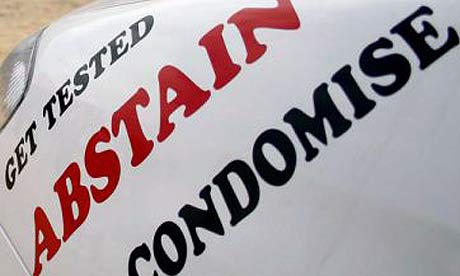
The ABC safe sex message, abstain, be faithful, condom use, displayed on a car bonnet. Photograph: AFP/Fati Moalusi
Speakers at the UN's first global symposium of men and boys in Rio de Janeiro this week have argued that macho stereotypes of what it takes to be a "real" man are helping spread HIV/Aids across the world.
Newswire IRIN is running an interview with Purmina Mane, an executive director of the UN Population Fund, who says the idea that men should have multiple sexual partners, take risks, are resilient to disease, reject contraception and be too strong to ask for help continue to affect access to healthcare and reproductive health services and is increasing exposure to the HIV virus for both men and women.
"Late diagnosis and treatment means that many continue to practice unprotected sex, running the risk of reinfection and of unknowingly infecting their partners," said Mane.
The story also quotes Graca Sambo, an executive director of Forum Mulher, a women's rights NGO in Mozambique, which said the idea that men should have many different sexual partners was a major contributing factor to the country having one of the highest HIV prevalence rates in the world – 16%.
"A lot of men have many sexual partners because this is what is expected of them," she said. "Masculinity is very much instilled by culture and by tradition, which say that men have to be studs." Read more
No comments will be posted without a full name and location, see the policy.
Sunday, 26 April 2009
Tolerance and the limits of acceptance
From The Guardian 'Face to Faith', David Bryant writes, "Tolerance of other faiths is not enough - we must strive for true acceptance":
[...] As we sink deeper into our private kingdoms, intolerance turns to active hostility. Disciples of other faiths are seen as potential threats, hopelessly misguided and far from God. Finally the whole religious edifice dissolves into war, fanaticism, discord and violence. At that point, the last faint glimmer of spirituality dies and only hatred remains.
Most people who believe in God take a less rigid stance when confronted with other faiths and opt for tolerance. We engage in cross-cultural dialogue and ensure that education is, as far as possible, all-embracing, not skewed towards one particular set of beliefs. We endeavour to set up a society which is broad enough to incorporate our different codes of dress, manners, customs and religious observances. On occasion faith leaders appear on public platforms shaking hands.
That is all right as far as it goes. But tolerance is an undemanding virtue, a poor effort at friendship. It often means no more than relegating to the category of irrelevant or faintly curious the deeply held beliefs of others. "So long as they don't encroach on my way of life, I'm easy." Or, "You get on with your rites and I'll stick to mine." This is a step up from religious despising, but it produces little more than an uneasy truce, an ineffectual admission that we belong to a multicultural, theologically disparate society and must make the best of a bad job.
Something far more radical and painfully sacrificial is needed if we are to ever engage meaningfully. We need to bring about a world of mutual, outward-going respect, a warmth that far surpasses mere tolerance. Read more
And from The Telegraph, Taliban gunmen shooting couple dead for adultery caught on camera:
No comments will be posted without a full name and location, see the policy.
"Christ did not die for the sins of the people": Head of German Catholic Bishops' Conference on TV
FREIBURG, Germany April 21, 2009 (LifeSiteNews.com) - According to the chairman of the Catholic bishops' conference of Germany, the death of Jesus Christ was not a redemptive act of God to liberate human beings from the bondage of sin and open the gates of heaven. The Archbishop of Freiburg, Robert Zollitsch, known for his liberal views, publicly denied the fundamental Christian dogma of the sacrificial nature of Christ's death in a recent interview with a German television station.
Zollitsch said that Christ "did not die for the sins of the people as if God had provided a sacrificial offering, like a scapegoat."
Instead, Jesus had offered only "solidarity" with the poor and suffering. Zollitsch said "that is this great perspective, this tremendous solidarity."
The interviewer asked, "You would now no longer describe it in such a way that God gave his own son, because we humans were so sinful? You would no longer describe it like this?"
Monsignor Zollitsch responded, "No." Read more
No comments will be posted without a full name and location, see the policy.
The Deconstruction Of Marriage and Family
It should go without saying that an open society must be tolerant towards different lifestyles among adults. However, the issue has long ceased to be that of tolerance, but of the dissolution of marriage bonds and family ties. Today’s boost in social status for homosexuality must be seen in conne ction with the social and sociopolitical tendencies towards the deconstruction and complete redefin ition of marriage and family and the dismantling and redesign of genders and generations.
The Deconstruction Of Genders
In recent years there was an increasing shift away from man and woman as basic
anthropological realities, towards heterosexual and homosexual identities which supposedly exist on an equal level. However, this, too, has now become ou tmoded. For quite a while now German universities no longer offer just “Gay -Lesbian Studies”, but “Queer Studies”.
“Queer” theories deny that humankind should fall into two gender categories. Instead of acknowledging mutually complementary manhood and womanhood, such theories hold that there are a variety of different genders which are all on a par with each other: heterosexuals, homosexuals, bisexuals, transsexuals, transgender sexuals, intersexuals and cross -dressers, to name but a few.
The University of Hamburg has been holding public lectures on “Queer Studies” since 1999. The declared aim of the lecture series is to “counter hetero -normativity … with something different”. The latest publication of the series gave the following definition of the word “queer”: “As a term in the political battle, queer stands against hetero-normativity, against the distinction of merely two genders and against patriarchal stru ctures.”
At the same time, the new genders are to be no rigid “pigeon holes”. Rather, it is to be a matter not just of “destabilizing the two-gender structure”, but of “removing the lack of ambiguity of gender and of sexuality”. One suggestion is to aim for the “diversification of genders” and therefore to abolish completely any references to gender as a c ategory in legal documents (e.g. in ID cards).
When requested to draft an official statement on the German Transsexuality Act, a number of leading sexologists proposed that it should be possible for people to change their registered personal status (e.g. from “male” to “female” in an ID card) if a person feels transsexual, irrespective of whether a sex change operation has taken place. A change in personal status and name should be subject to no more than a medical report and the person’s statement that their “perceived gender membership” does not match their “biological gender”. Download as pdf
No comments will be posted without a full name and location, see the policy.
Public Resistance against Homosexualization of Society Launched in Germany with Over 600 Prominent Signers
Preparations for a conference on psychotherapy set for May in Marburg, Germany are being disrupted by an "action alliance of queer, feminist, and anti-fascist and anti-sexist" groups that want two Christian therapists removed from the roster of speakers.
In response, a group of at least 600 prominent German professionals from a wide variety of backgrounds has issued a public statement and petition to protest the "totalitarian aspirations of the gay and lesbian associations." These organizations, they said, are trying to suppress freedom of expression and academic inquiry at the upcoming 6th International Congress for Psychotherapy and Counseling in Marburg.
On March 29, the Lesbian and Gay Association of Germany (LSVD) in an open letter to the mayor of the city of Marburg and the university, attacked the management of the Congress, saying that a talk scheduled by two experts on "identity development for men and women" should be cancelled. Read more
No comments will be posted without a full name and location, see the policy.
Psychiatrist, Therapist and Rabbi say Gays can change
A high police presence and over 100 gay activists failed to prevent participants at a two-day Sex & the City Conference from an opportunity to hear reparative therapist Dr Joseph Nicolosi; psychiatrist, author Dr. Jeffrey Satinover; and JONAH President Arthur Goldberg. The three told their audience that change is not only possible for homosexuals with same-sex attraction, but that thousands of men and women have thrown off homosexual behavior with many marrying and now living normal lives.
Joseph Nicolosi"It’s all about choice, choice, choice," said Nicolosi. "Individuals have the right to explore their heterosexual potential. It is about freedom of choice. It is about diversity, autonomy, self-determination. The language gays are using, we are using. We say ‘who are you to judge, let me decide for my life. I don’t want gays telling me I can’t change.’ All the cliches used by gay activists, we are using for ex-gays."
Nicolosi argues that, at its root, homosexuality is not a sexual problem - it is a gender-identity problem. Normal stages of emotional development have been interrupted, and this can lead to same sex bonding in order to attain affirmation. These relationships tend to implode, leaving the homosexual hurt and confused. Furthermore, Nicolosi claims that there is no such thing as a homosexual, but only heterosexuals that have a homosexual problem. "This may sound like splitting hairs, but it actually opens the door for the dissatisfied homosexual oriented person to change, because such people can begin viewing themselves as fundamentally heterosexual. We have had a great deal of success with this therapeutic approach." Read more
No comments will be posted without a full name and location, see the policy.
Saturday, 25 April 2009
Giles Fraser: No tasks left for the risen Jesus
THIS WEEK it is 900 years since the death of Anselm of Canterbury, arguably most noted for his invention of the ontological argument, and for putting up the scaffolding for the theory of penal substitution, only really finished off by Calvin in the 16th century.
Now, while I think the ontological argument is a pretty harmless parlour game for brainboxes with too much time on their hands, penal substitution is a very bad thing indeed.
Some Christians get very worked up by anyone’s having a go at penal substitution. This is largely, I think, because they confuse this medieval-cum-Reformation reading of salvation with the gospel itself, and just cannot see that penal substitution is one reading of the text among others.
The basic idea is that human beings owe God an unpayable debt on account of their sin, and that Jesus pays off this debt by being nailed up on a cross. To many of us, this account turns God into a merciless loan shark, deaf to our pleas for forgiveness. Whatever happened to “I desire mercy not sacrifice” (Hosea 6.6, Matthew 9.13)?
Another weakness is that it gives the resurrection nothing to do in the overall scheme of human salvation. If we are saved on the cross, then there is no saving work left for the resurrection to do. Thus it gets sidelined as a spectacular after-party to the main event, which gets wrapped up on Good Friday.
That just can’t be right. Those who insist otherwise might like to take a closer look at Anselm’s Cur Deus Homo? (“Why a God-Man?”), where he sets out his understanding of salvation. It is made up of 47 mini-chapters; all have titles, but not one of them refers to the resurrection. Indeed, the resurrection hardly merits a mention throughout the whole book — a book on human salvation. No wonder so many of us find penal substitution so unconvincing. Read more
No comments will be posted without a full name and location, see the policy.
Evangelical appointed Bishop of Sherborne
A leader of a prominent evangelical grouping in the Anglican war over gays has been appointed bishop to one of the oldest historic Episcopal seats in the country.
Although Sherborne, founded in 705, is no longer a see in its own right but an area in the Salisbury diocese covering Dorset, the appointment Dr Graham Kings as its bishop is one of the strongest signs yet that the Archbishop of Canterbury is winning the battle for Anglican unity.
Dr Kings is founder of the increasingly influential group Fulcrum, which publishes the writings of conservative evangelical Bishop of Durham, Dr Tom Wright.
Fulcrum, based at Dr Kings’ present church of St Mary’s Islington, has campaigned for orthodoxy without schism in the Church of England.
Fulcrum is aligned theologically with conservatives in North America who are also attempting to maintain a conservative agenda without schism.
Unlike other conservative bishops, clergy and laity who have already left, the centrist conservatives are resisting moves to defect over the consecration of a gay bishop and the blessing of same-sex marriages.
Fifteen of these bishops in The US Episcopal Church, who belong to the Anglican Communion Institute, this week published a statement arguing for the recognition of the individual diocese as “church” rather than the national province.
If these were accepted, it would mean that dioceses could individually sign up to the new unity document, the Anglican Covenant, even if a national church refused to do so because it wished to pursue a more liberal pro-gay agenda.
Dr Kings said he believed the strategy of Dr Rowan Williams to attempt to keep most conservatives and liberals on board through the “covenant process” was working. Read more
No comments will be posted without a full name and location, see the policy.
Friday, 24 April 2009
Doctors criticise Anglican Mainstream conference on 'gay treatment'
Plans to promote medical treatment for homosexuality at a religious conference have been criticised by doctors.
The event will hear from prominent American psychologist Dr Joseph Nicolosi who said he had helped many people to become heterosexual.
But the Royal College of Psychiatrists said there was no supporting evidence and such treatment could be damaging.
The two-day conference being held in central London has been organised by the church group Anglican Mainstream.
Dr Nicolosi said he had been helping people to "increase their heterosexual potential" for 25 years, and put his success rate among men at about two out of three.
He said he was offering a choice for people who were unhappy being gay. Read more
Full details of the Conference may be seen here.
Sex and the City
A Judaeo - Christian conference for all
With Joseph Nicolosi, Ph.D. (NARTH)
author of Shame, Homosexuality and the Practical Work of ReparativeTherapy (IVP, to be released April 2009)
Jeffrey Satinover, M.D., Ph.D. author of Homosexuality and the Politics of Truth
Arthur Goldberg, J.D. author of the just-released Light in the Closet:Torah, Homosexuality, and the Power to Change, with others.
Friday and Saturday, 24th and 25th April, 2009, 9:30 am - 5:30pm
Central London venue
COST £30/day, £50/both days (including morning coffee and afternoon tea), drinks reception/panel discussion Friday evening, 6.30- 8.30 pm, materials and registration
CONTACT ls.n@talktalk.net
No comments will be posted without a full name and location, see the policy.
Thursday, 23 April 2009
Bishops' Statement suggests approach of TEC endgame
A very lengthy statement signed by a number of conservative TEC bishops has been published by the Anglican Communion Institute.
The gist of the paper seems to be that the historical basis of The Episcopal Church as a conglomeration of independent dioceses without a formal Primate or Metropolitan means that the existing Presiding Bishop has been acting consistently ultra vires - beyond her proper powers.
It is possible to read comment on this on a number of blogs, both Liberal and Conservative, such as Thinking Anglicans, Baby Blue Online, Stand Firm, and so on.
One thing that seems clear, however, is that the present atmosphere within TEC, even amongst those committed to staying, admits no quarter on the issues dividing that body. This provides further support to the suggestion on the Ugley Vicar Blog that we have reached the point of 'Game Over' as regards a covenant-based rescue plan which will restore the Anglican Communion to the point at which it was pre-Lambeth 1998.
There seems, as yet, to be little response from English 'Communion Conservatives'.
Ed
No comments will be posted without a full name and location, see the policy.
Tuesday, 21 April 2009
Faith Diary: Kosher exorcisms
Bumps in the night, unearthly sounds, deathly cold rooms - all the usual ingredients of a supposed haunting. But as Robert Pigott reports in this week's Faith Diary, the kosher solution to a Jewish poltergeist doesn't involve a bell, book and candle. Also this week - what was cooking between the Queen and the Cardinal and why Jordan is praying for a windfall of tourist dollars.
CALLING THE KOSHER GHOSTBUSTERS
When Jesus miraculously cast "unclean spirits" out of man and into a herd of swine at Gadara in Jordan 2,000 years ago, he was setting the stage for exorcisms which continue in the present day.
Each diocese in the Church of England provides a priest to take on the role of exorcist for those rare occasions when it is deemed necessary.
But the most recent need has emerged in a London synagogue.
The rabbi at Enfield and Winchmore Hill synagogue had recently moved into the accommodation attached to the synagogue when he found he had been joined by an unseen force capable of opening windows, as well as knocking at doors and making other inexplicable noises.
Corroboration for the presence of a spirit has come from members of the synagogue's congregation, who say they have noticed the spectral activity before.
The ghost was believed to be that of the rabbi who founded the synagogue and who died 40 years ago. Read more
No comments will be posted without a full name and location, see the policy.
Gay marriage row at Miss USA show
The runner-up at the Miss USA beauty pageant says her outspoken opposition to gay marriage cost her first place in the competition.
During the televised event, Carrie Prejean - Miss California - said she believed that "a marriage should be between a man and a woman".
She had been asked for her views on the subject by one of the judges, celebrity blogger Perez Hilton.
"It did cost me my crown," said Ms Prejean, after the competition.
The eventual winner of the pageant was Kristen Dalton, Miss North Carolina. Read more
No comments will be posted without a full name and location, see the policy.
Church of Scotland magazine backs gay partnerships
A potential rift within the Church of Scotland over gay relationships emerged yesterday after the Church’s house magazine backed civil partnerships and openly gay ministers.
Accusing religious traditionalists of selectively quoting the Bible to support their attacks on homosexual relations, the editorial in Life And Work urged the Kirk to show strong leadership on an issue that has threatened to split the Church of England and could prove just as divisive in Scotland.
The article, which was written by the magazine’s editor, Muriel Armstrong, comes ahead of next month’s General Assembly in Edinburgh and has been timed to influence a key debate on whether openly homosexual ministers can be appointed to the Church. Read more
No comments will be posted without a full name and location, see the policy.
Monday, 20 April 2009
Genetic research in a "blind alley" in search for cures for common diseases
Professor Steve Jones, one of Britain's top geneticists, said the belief that a few genes held the key to ridding the world of conditions such as cancer and diabetes has proved to be "plain wrong".
In most cases hundreds of genes are responsible, and often they have less effect than other factors such as diet, lifetstyle and the environment people live in.
Writing in the Daily Telegraph, the academic and author led calls for a complete overhaul of the "scattergun" approach, which is backed up by millions of pounds in funding by governments and medical charities such as the Wellcome Trust.
He said he was one of a number of "renegade" scientists who were beginning to question such research: "It's not done to kill the goose that lays the golden eggs, nor to bite the hand that feeds you - nor, in my own profession, to criticise the research programme of the Wellcome Trust, an enormously rich charity that paid much of the bill to read the message written in human DNA. Read more
No comments will be posted without a full name and location, see the policy.
The Anglican schism widens quietly
In an airport hotel there is no avoiding the impression that everybody else is on the way to somewhere more important, or is already there. The feeling grew when I walked into yesterday's press conference outside Heathrow: the Renaissance suite could have held 360 people. In fact there were half-a-dozen archbishops and bishops connected with the Anglican conservative tendency, plus fixers and hangers-on. And me.
This was no reflection on the archbishops, of course, and only a little on the hotel. It was principally, I'm sure, that in the week after Easter, heading up to Low Sunday, religious journalists, like everybody else, want to take a break. Tough on the press officer, but these things happen. So we moved some chairs and sat in a small circle, and I asked questions for 45 minutes, and then they went off to lunch, and I got back into my car and drove home.
And as I sat on the M25, I reflected on what I'd heard, trying desperately to avoid the traffic analogies that came unbidden into my mind. For the international Anglican Communion, all 38 provinces and 77 million worshippers of it, has been coming apart over the past decade or so, and these archbishops were saying they want to put it back together again. Except that, to many of their fellow Anglicans, these archbishops have been leading a breakaway movement and have been instrumental in the divisions. Read more
No comments will be posted without a full name and location, see the policy.
TEC files suit against Bishop Iker
The Episcopal Church’s headquarters in New York, along with a group of loyalist supporters in North Texas, has filed suit against Fort Worth Bishop Jack Iker and his diocese’s officers, seeking possession of the diocese’s properties.
In a statement released on April 14, US Presiding Bishop Katharine Jefferts Schori said the national church and the loyalist group were asking a Texas court to declare them the “rightful owners of all diocesan property, real and personal, including funds and endowments.” Read more
No comments will be posted without a full name and location, see the policy.
Fried or frozen, the solar systems that may have had life
A glimpse of the bleak fate that awaits the Earth in billions of years has emerged from research into dying stars that once blazed as brightly as the Sun.
Astronomers have discovered that at least one in 100 white dwarfs — the burnt-out remnants of Sun-like stars — once had solar systems, with planets that were destroyed or deep-frozen by the death throes of their stars
The research, by a team led by Jay Farihi, of the University of Leicester, suggests millions of other solar systems have endured the destiny predicted for the Earth when the Sun dies.
“What we have seen is a possible fate for our own solar system,” Dr Farihi said. “Many of the systems we are studying will have been similar to our own. It’s a possibility that some of them could once have held life.” Read more
No comments will be posted without a full name and location, see the policy.
Sunday, 19 April 2009
Church of England bishop accused of trying to set up rival church
The Very Rev Colin Slee, the liberal Dean of Southwark has publicly attacked the Bishop of Rochester, Dr Michael Nazir-Ali, and said that he was one of three bishops whose position was now "open to some debate".
The Dean's broadside, delivered in the introduction to the annual report for Southwark Cathedral, will infuriate evangelical supporters of the Bishop, 59, and further widen the gulf between the traditional and liberal wings of the church.
The report was distributed to worshippers who attended last week's Easter Sunday celebration at the Cathedral.
In the article, Mr Slee argues that the decision by the Bishop of Rochester, Lewes and Willesden to boycott last year's Lambeth Conference, a meeting of Anglican bishops from around the world which is held every ten years, raises serious questions about their future within the Communion. Read more
No comments will be posted without a full name and location, see the policy.
Wilders plans new film about 'Islamisation' of West
The far-right Dutch MP Geert Wilders is planning a follow-up of his provocative anti-Koran film, Fitna. The outspoken, peroxide-blond leader of the opposition Freedom Party, who has labelled the Koran "fascist", says the new film will deal with the growing Islamisation of Western countries.
"Our doors are wide open to mass immigration from Muslim countries and I want to show the consequences of this," Mr Wilders told the newspaper De Telegraaf. The film would tackle freedom of speech and Sharia. "And I will offer solutions," he said.
Fitna, a 17-minute video that juxtaposes the turning pages of the Koran with images of terrorist attacks, was released on the internet last year after months of speculation over its content.
Fearing attacks on his country, the Dutch Prime Minister, Jan Peter Balkenende, had even called for it to be censored though the public response was in the end milder than expected.
Dutch Muslim organisations condemned the film but it did not spark violence, despite a final scene showing a hand tearing up a page of the Koran (Mr Wilders later said the sound for the scene had been taken from the tearing up of a telephone directory).
However, the National Counter-Terrorism Coordination Services said yesterday that they had "taken note" of the new announcement and would monitor the security situation. Read more
No comments will be posted without a full name and location, see the policy.